Can a local AI model translate a patent?
The appeal of a local AI model is obvious: the document never leaves your computer. So I tested one properly, on a real patent, and wrote it up on the Supervertaler website.
I used a published Belgian patent (BE1029761B1, a roller brake tester) that WIPO also published in English, as WO2023042137A1. That gave me a real filing translation of exactly this text, with both versions public, so it was safe to try anything on it.
I pre-translated it twice in memoQ, using Supervertaler for memoQ, with the same settings both times: once with Gemma 4 31B, about the largest model a well-equipped PC can run, and once with Claude Opus 5.5. (I ran Gemma through Ollama’s cloud service to save time; it’s the same model you can download.) Then I compared both with the published English, paragraph by paragraph and claim by claim.
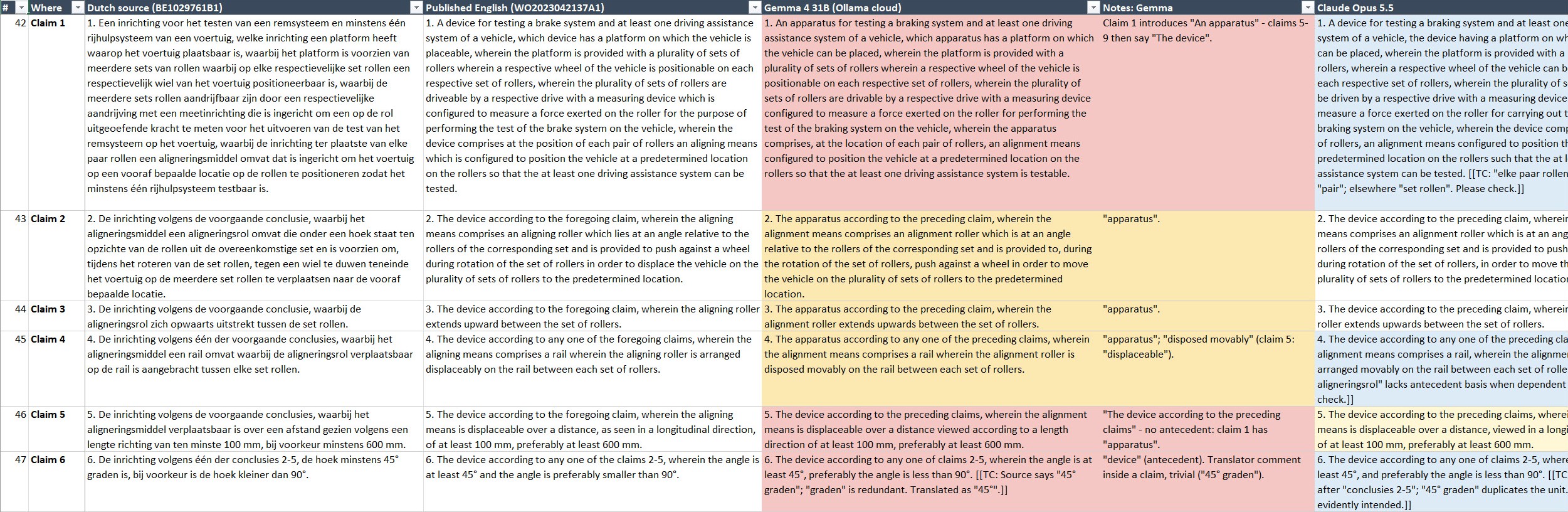
Claims 1 to 6 in the comparison spreadsheet. Red: a problem that breaks the claims. Amber: meaning or consistency. Pale yellow: minor. Blue: a comment from the model on the Dutch source. Click to enlarge.
What I found:
- Gemma writes fluent, mostly accurate patent English, but its terminology drifts. The same inrichting became “apparatus” in claims 1–4 and “device” in claims 5–9, and in a patent that breaks the claims.
- Claude kept one name for every part from start to finish, and pointed out a missing antecedent in claim 4 of the Dutch original.
- House rules make a real difference. I added six Dutch patent conventions that Gemma kept getting wrong to my SuperMemory notes, one line each, and it applied all six on the next run.
- Smaller models (7–8B) weren’t good enough for patent work at all.
So for now, a local model gives you a draft that needs a thorough post-edit. For work that has to be right, I use a strong cloud model under business terms – how I handle that is on my confidentiality page.
The full write-up, with every paragraph side by side and the comparison spreadsheet: Can a local AI model translate a patent?