Termania: Interview with Michael Beijer in 'Why is terminology your passion?'
In 2013, I was one of 26 terminologists interviewed by trainees from the European Parliament’s Terminology Coordination Unit (TermCoord) for ‘Termania’, a section of their blog at termcoord.eu. That website has since been taken offline.
In October 2014, the interviews were collected in the free e-book Why is terminology your passion? A collection of interviews with prominent terminologists (European Union, 2014, ISBN 978-92-823-6176-4, doi:10.2861/7415). My interview is on pages 95–101. You can download the PDF from the Publications Office of the EU.
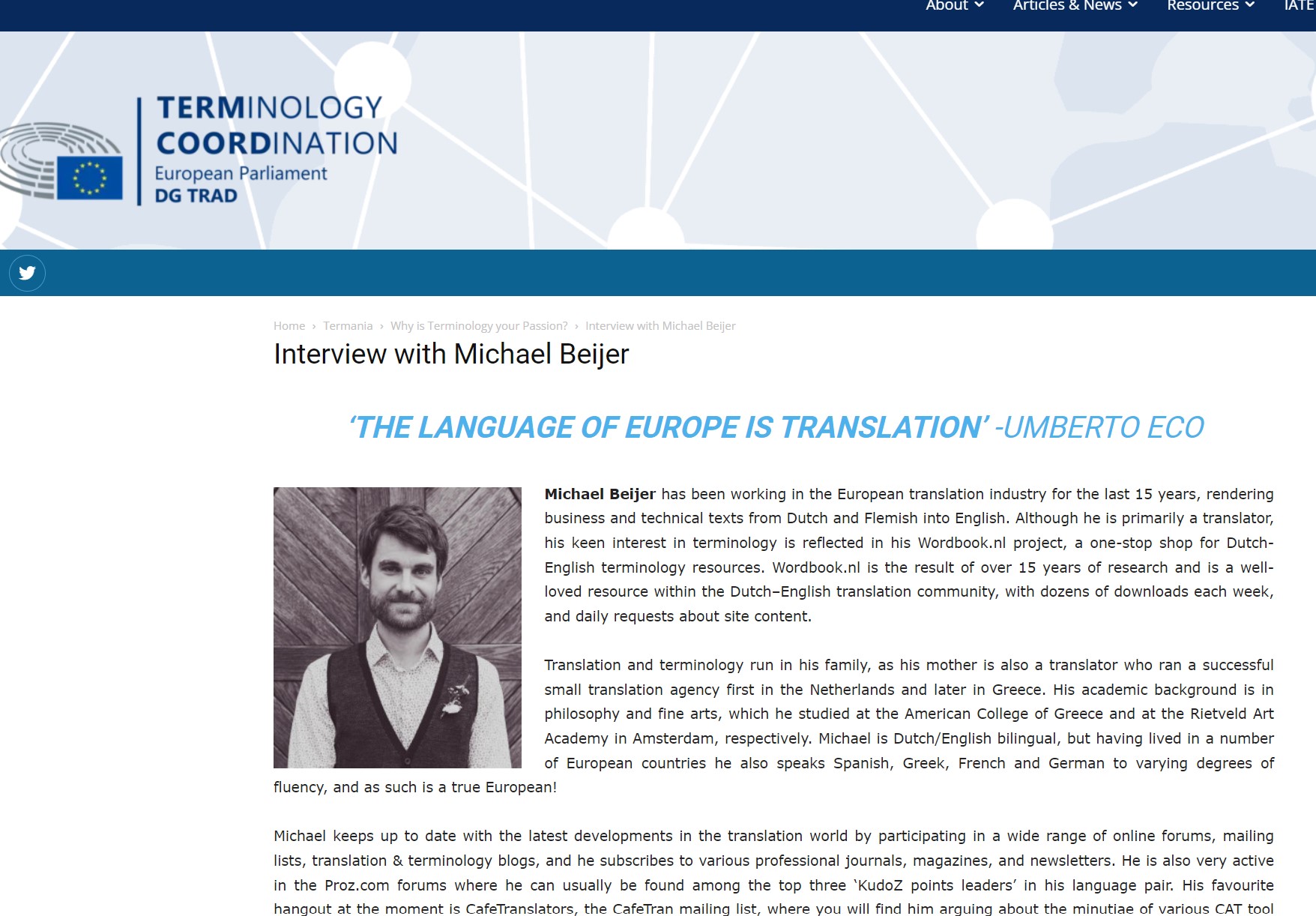
The interview below is reproduced as published in the e-book, with a few passages removed that no longer reflect how I work. The Wordbook.nl project I talk about was the first version of what is now Beijerterm.
Interview with Michael Beijer
by Müslime İlhan
‘The language of Europe is translation.’ – Umberto Eco
Michael Beijer has been working in the European translation industry for the last 15 years, rendering business and technical texts from Dutch and Flemish into English. Although he is primarily a translator, his keen interest in terminology is reflected in his Wordbook.nl project, a one-stop shop for Dutch-English terminology resources. Wordbook.nl is the result of over 15 years of research and is a well-loved resource within the Dutch–English translation community, with dozens of downloads each week, and daily requests about site content.
Translation and terminology run in his family, as his mother is also a translator who ran a small successful translation agency, first in the Netherlands and later in Greece. His academic background is in philosophy and fine arts, which he studied at the American College of Greece and at the Rietveld Art Academy in Amsterdam, respectively. Michael is Dutch/English bilingual, but having lived in a number of European countries, he also speaks Spanish, Greek, French and German to varying degrees of fluency, and as such is a true European!
Michael keeps up to date with the latest developments in the translation world by participating in a wide range of online forums, mailing lists, translation & terminology blogs, and he subscribes to various professional journals, magazines, and newsletters. He is also very active in the Proz.com forums where he can usually be found among the top three ‘KudoZ points leaders’ in his language pair. His favourite hangout at the moment is CafeTranslators, the CafeTran mailing list, where you will find him arguing about the minutiae of various CAT tool features and brainstorming ways of improving them.
1) Could you please tell us a little bit about yourself?
I am a full-time professional translator and terminologist with over 15 years of experience working in the European translation industry. I refer to myself as a ‘translator & terminologist’, but I could just as well call myself a ‘language consultant’, ‘CAT tool consultant’ or ‘linguist’ instead. However, while I have many different interests and am constantly discovering new things, I pay my bills translating and doing terminology extraction and consulting, so that’s what ends up on my calling card.
I translate mainly business and technical texts from Dutch and Flemish into English. Although I spend most of my time translating audit reports, contracts and product manuals, I have recently also become interested in literary translation. I am also well-known online as a translation technology nerd, and I am an active member of many mailing lists relating to translation, CAT tools and terminology. One of my favourite pastimes is arguing about the nuts and bolts of the technical side of CAT tools in the CafeTran and memoQ mailing lists. I am also very active on the Proz.com forums for translators, where I spend a lot of time helping beginner translators translate difficult terms and asking more experienced ones for help myself.
2) Could you briefly describe what the following phrases remind you of?
Terminology: I used to call myself just a translator. I added ‘terminologist’ only recently because I realised that my particular style of translating relies heavily on knowing the correct terminology. My forte is technical contracts or specialised and detailed product manuals. These are areas with highly standardised and specific terminology where consistency is of prime importance. For example, using three slightly different terms to refer to a specific device in a 50-page manual is not going to do anyone any good. Correct terminology and terminological consistency are therefore both extremely important in my work and this realisation soon led me to start paying much more attention to terminology.
Simultaneous interpreting: I don’t feel that simultaneous interpreting is a good mesh with my own abilities and so I have steered away from it. As befits a terminologist, my working style involves extensive use of computer-based tools and other reference materials. I am much better suited to meticulous research and cross-referencing than speed and ease of translation, and this has led me to develop these skills instead, although I have the greatest respect for those who can work under such pressure and at such high speed – and for their excellent memories! My focus continues to be on improving the industry’s terminology research and glossary creation methodologies and technologies. Language work is a broad field and there are as many different aptitudes within it as translators – knowing your own strengths and working on developing them is key to a successful career.
The EU’s 24 official working languages: The more the merrier! The wide range of working languages can only mean more work for us translators, particularly as the number of official languages means that terminological consistency is a pressing issue for the EU, which is where I come in. I am also especially pleased that the EU has provided such a large amount of good translation memories (the DGT-TMs, etc.), although these do contain their fair share of mistakes and must therefore be used with circumspection.
3) Could you describe your Wordbook Project? What is your source of inspiration for this project?
The term ‘Wordbook’, for me, encompasses a range of different possibilities. Perhaps the most concrete and accessible of these right now is the Wordbook webpage, hosted on my website. Here visitors can access over 350 resources, including different Dutch-English dictionaries, glossaries and search websites. Between one and five glossaries are downloaded daily, and the site attracts hundreds of visitors per month. Much of my work has been to source appropriate resources and to present them in a variety of formats, including tab-delimited UTF-8 text files – that is, files that can be imported directly into CAT tools. This puts high-quality, specialised terminology at your fingertips, so you can spend less time looking up terms and more time translating.
Wordbook has been my pet project for the last five years, as can be seen from the glossaries in my own CAT tool, memoQ, currently comprised of over 500,000 entries. My dream is to one day develop Wordbook into a collaborative online dictionary for translators, rather like a wiki in principle, where community members will be able to contribute to a bank of language resources that would be available for all to use freely.
4) Isn’t it hard to keep the glossaries update all the time?
Keeping Wordbook.nl up to date is indeed a lot of work. I usually work on it in bursts, depending on how much free time I have. However, I do always try to add any new resources I might come across during my day-to-day work. I usually quickly open up Dreamweaver and add the link. If I have a little extra time I might also download the glossary in question and convert it to my standard tab-delimited UTF-8 text file format, and then upload it to the content directory of Wordbook.nl, linking it to my entry in the resource directory.
5) Do you want to publish your own dictionary one day (if yes/no why)?
I once did, yes, but I soon realised what that would really mean in terms of time and effort, and quickly wrote it off as a youthful fantasy! I currently subscribe to three of the best specialist online reference works for my language pair, and using them soon showed me exactly how much work goes into writing and maintaining a good dictionary. In fact, this realisation was what drew me toward an alternative, collaborative approach to terminology, and I am extraordinarily grateful for the improvements in technology that make this approach more and more feasible.
6) What are the challenging aspects of Terminology Work that you face most?
One of the hardest things about terminology work is how little translators know about terminology. Even CAT tool developers are relatively uninformed as to the interaction between their software and its applications to the real job of translating. From the user’s perspective, translating is hard enough as it is without having to constantly hack your tools to try and get them to do what you want. I have wasted a lot of time fighting with my translation tools – time that would be better spent on my work itself. You would be surprised how many translators don’t even use the glossary feature in their CAT tools. Another thing that puzzles me is how many translators aren’t even aware of the fact that there are a number of very good dictionaries (both print and online) that would greatly assist them in their daily work. I feel strongly that investing a bit of time and money in learning about these possibilities pays dividends, but there is still a lot of educative work to be done in order to encourage people to take advantage of them.
7) What advice could you give to young Terminologists?
Focus on the content. How you find, edit, sort, manage, store and access your terminology (its ‘form’) is of course also important, but without good content, what’s the point? It might be fun or intellectually stimulating to devise The Ultimate Terminology Management System (believe me, I have tried), but when it comes down to it, you are going to need something to put in it. Unless you are one of the lucky few, you are also going to need to pay your bills – that is, you are going to need to find someone who is willing to pay you for your work.
One of the things that got me into terminology, for example, was large LSPs (Language Service Providers) asking me if I could extract monolingual glossaries for them from massive amounts of corporate data. These (usually English) glossaries of mine would then be translated into scores of other languages to create a basic glossary that would be sent to all of the translators in large, multilingual translation (or ‘localisation’) projects. Another area where terminologists are in constant demand at the moment is in the world of online business. Corporate keyword consultancy and multilingual search websites and glossaries (supported by ads) are both budding new areas for tech-savvy terminologists trying to get a foothold.
8) Do you think that Terminology should be a separate discipline at universities rather than a sub-branch of Translation Studies?
I am probably the wrong person to ask, as funnily enough I have no academic training in translation or terminology work. However, if I were to hazard a guess, I suppose I would have to say yes. After all, not all terminology is bilingual or multilingual. Monolingual terminology, for example, has very little to do with translation. As shown by the relative reluctance of translators to delve far into terminology, there are many specific technical skills that apply to the creation, management and dissemination of terminological resources, and I believe the relative paucity of skills in this area is one reason why translators shy away from accessing the wealth of resources floating around out there. The industry needs more skilled terminologists with programming skills who can help close this gap, to improve data management and create user-friendly resources, and these technical skills are not addressed in traditional translation courses.
9) Do you define yourself more as a Translator or a Terminologist? Or which work do you prefer more and why?
Although I have a lot of fun hunting down the right term online or in my many dictionaries and slowly improving my own glossaries and term bases, I will always be a translator at heart. Anyone who knows me will tell you that terminology is always at the forefront of my mind when working on a translation, and I turn this to my advantage when choosing work to undertake. So, for me, the two are inextricable.
About the interviewer: Müslime İlhan was born in 1989 in Şanlıurfa (Turkey) but lived in Nürnberg, Germany since she was 2 months old. She attended the Maria Ward Private High School in Nürnberg where she learned English, Latin and French. Müslime obtained her Bachelor’s Degree in Translation and Interpretation (English, German & Turkish) at both the Hacettepe University in Ankara/Turkey and the University of Strasbourg. She also holds an Associate Degree in Law from the Anadolu University. Müslime wants to begin her Master’s Degree in Human Rights or International Relations and currently works as a Translator and Interpreter at the Constitutional Court of the Republic of Turkey. She wants to help build a future in which everyone respects human rights, human dignity and equality.